
OIR-B1-1802 · Florida Insurance Form The 2026 Wind Mitigation Form, Explained
Florida's Uniform Mitigation Verification Inspection form is two pages of checkboxes that move real money. Here’s what the current 2026 edition asks, why editions matter to carriers, and how Lunar completes every section.

The OIR-B1-1802 — the Uniform Mitigation Verification Inspection form — is how Florida standardized wind-credit documentation. One form, statewide, read by every carrier: an inspector attests to seven construction features, photographs the evidence, signs under license, and the carrier’s underwriter converts those attestations into premium credits under §627.711, Florida Statutes.
Because the form is the legal instrument, its edition matters. Carriers process the current version; superseded editions risk rejection and re-inspection delays. This guide walks you through the current 2026 edition — what it asks, what each section means in plain English, and what you’ll receive when Lunar completes it.
In this guide
Why the edition on the form matters
The wind mitigation form is updated periodically by the Florida Office of Insurance Regulation. When the form edition changes, carriers update their intake systems to match. A report submitted on a superseded edition — even if the inspection itself was thorough — risks being kicked back for re-inspection. That’s wasted weeks at exactly the moment you’re trying to bind or renew coverage.
Every Lunar wind mitigation inspection is completed on the current 2026 OIR-B1-1802, with the photo-documentation pack underwriters expect attached — truss, eave, and opening.
The form edition is not cosmetic. It’s the legal instrument your carrier processes. A wind mitigation inspection on an outdated form is like filing a tax return on last year’s 1040 — the data may be correct, but the document gets rejected.
The OIR-B1-1802 is the Uniform Mitigation Verification Inspection form, published by the Florida Office of Insurance Regulation (FLOIR). It is the statewide standard for documenting wind-resistant construction features that qualify a home for hurricane-premium discounts under §627.711, Florida Statutes.
In practical terms, the form is two pages. Page one collects building and permit data. Page two is the attestation grid — seven construction features, each requiring photographic evidence and an inspector’s licensed signature. The carrier’s underwriter reads this grid and maps each answer to the credit schedule that applies to your policy.
- Published by the Florida Office of Insurance Regulation (FLOIR)
- Governs premium credits under §627.711, Florida Statutes
- Completed and signed by a licensed Florida home inspector, general contractor, or professional engineer
- Valid for approximately five years — across multiple renewal cycles
- The official form is available through floir.com
What the form asks, line by line
Seven features, each an attestation with photographic evidence — the same seven our inspection documents every visit. Together, they tell the carrier everything it needs to calculate your wind-credit eligibility.
-
01
Building code / permit date
When the roof was built or last permitted — the baseline that scales every other credit on the form. Post-2002 construction under the Florida Building Code earns stronger credits across the board.
-
02
Roof covering
The covering type and whether it meets current wind-rating standards, with permit verification. FBC-approved coverings installed under permit carry the credit; unpermitted replacements do not.
-
03
Roof deck attachment
Nail type, size, and spacing holding the deck to the framing — verified in the attic, photographed at the truss. 8d ring-shank nails at 6″ spacing is the most common qualifying pattern.
-
04
Roof-to-wall attachment
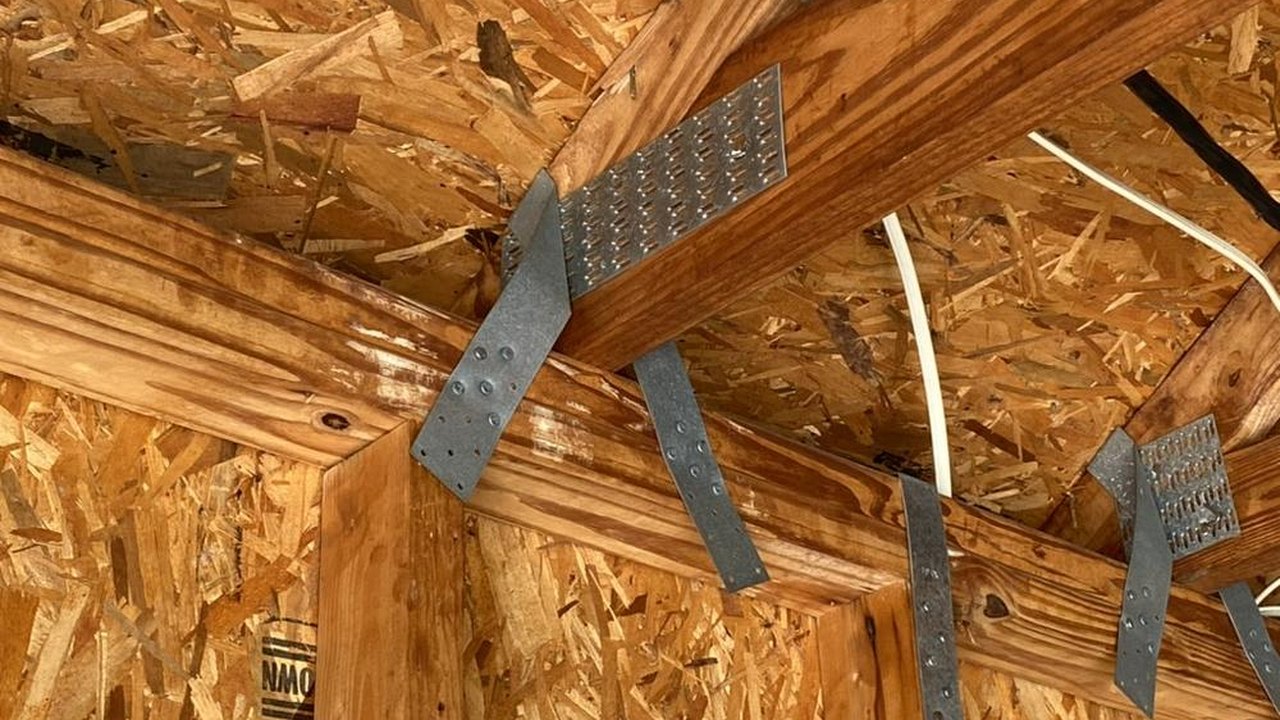
Toe-nails, clips, single or double wraps — the connection hierarchy that anchors one of the largest credits on the form. Double wraps earn the highest discount; toe-nails earn none.
-
05
Roof geometry
Hip, gable, flat, or mixed — measured and photographed. Hip geometry earns the strongest credit because hip roofs distribute wind loads more evenly than gable profiles.
-
06
Secondary water resistance (SWR)
Sealed roof-deck barriers documented by evidence — membrane at seams or foam adhesive at the deck. SWR is difficult to retrofit, but when present it earns a meaningful credit.
-
07
Opening protection
Impact ratings for every window, door, and skylight — documented per opening, at the classification level the form requires. Full hurricane-rated opening protection earns the top-tier credit for this feature.
Key takeaway
- Features are documented, not scored. The inspector attests to what’s there; the carrier applies the credit schedule. A wind mitigation inspection is an observation report, not a pass/fail exam.
- Photo evidence is mandatory. Every attestation is backed by photographs — attic trusses, roof-to-wall connectors, opening labels, and exterior geometry.
- One form, statewide. Whether your carrier is Citizens, Universal, or a private mutual, they all read the same OIR-B1-1802.
How Lunar documents the form
A wind mitigation is a field documentation exercise — the inspector physically verifies each of the seven features and photographs the evidence the carrier expects. Here’s how Lunar approaches it.
Every Lunar wind mitigation ships with a photo-documentation pack — attic trusses, roof-to-wall connectors, roof covering close-ups, and labeled opening shots. These aren’t for your file cabinet; they’re what the underwriter uses to verify the attestation without scheduling their own inspection.
Brian Walker personally performs and signs every wind mitigation under FL License #HI-14111. The form carries a licensed inspector’s signature — never a subcontracted crew. One inspector, one standard, every visit.
The completed OIR-B1-1802 and photo pack are delivered digitally, typically within 24 hours — ready to submit to your carrier, agent, or underwriter. No waiting, no follow-ups for missing photos.
Two pages of checkboxes, read by every carrier in the state. Editions matter.
Brian Walker, Certified Master InspectorEvery Lunar wind mitigation delivers a complete, carrier-ready package — not just the form, but everything the underwriter needs to process credits without callbacks or re-inspection requests.
- 2026 OIR-B1-1802 — the current statewide edition, completed in full with all seven attestations
- Photo evidence pack — attic trusses, roof-to-wall connectors, covering close-ups, opening labels, and exterior geometry
- Signed under license — FL Home Inspector License #HI-14111, Certified Master Inspector
- Valid approximately five years — across multiple renewal cycles with your carrier
- Digital delivery within 24 hours — ready to forward to your agent, carrier, or underwriter
Need a 4-point inspection too? Most carriers want both. Our insurance bundle combines wind mitigation + 4-point + roof certification in a single visit — one trip, one report package, one day.
Common questions about the form
Why does the form edition matter?
Carriers process the current state form. A report submitted on an outdated edition risks being kicked back for re-inspection — wasted weeks at exactly the moment you’re trying to bind coverage. Every Lunar wind mitigation is completed on the current 2026 OIR-B1-1802.
Where can I see the official form?
The OIR-B1-1802 is published by the Florida Office of Insurance Regulation — available through floir.com. What you’re reading here is a plain-English guide to what it asks; the form itself is the legal document your inspector completes and signs.
Do I need a new inspection because the form updated?
Not necessarily — an existing report remains generally valid for its five-year window. But if your carrier requests the current edition, or you’ve upgraded a feature since your last inspection, a new inspection on the current form is the clean answer.
Does Lunar charge more for the current form?
No — the current edition is simply what a wind mitigation inspection is. Flat pricing is on the pricing page.
What if my home doesn’t qualify for any credits?
The inspection still documents what’s there — honestly. Some homes have construction features that don’t earn credits under the current schedule, and that’s a legitimate outcome. The report tells your carrier the truth, and you’ll know exactly which upgrades (if any) would change the result.
Next steps
If your carrier has requested a wind mitigation — or you want to find out what credits your home qualifies for — schedule it early. A completed OIR-B1-1802 on the current edition, with photo documentation, is the cleanest path to binding or renewing coverage with every available discount applied.
Schedule a wind mitigation inspection, bundle the 4-point if your carrier wants both, and we’ll deliver the insurer-ready report, typically within 24 hours. Not sure what you need? Find My Inspection takes under a minute.
“A property and casualty insurer shall provide a premium discount, credit, or other rate differential … for fixtures or construction techniques demonstrated to reduce the amount of loss in a windstorm.”
§627.711, Florida StatutesThis resource is provided for general educational purposes for Florida homeowners, buyers, and investors. It is not legal, engineering, or insurance advice, and it is not a substitute for a professional inspection of a specific property, nor for the official form and its instructions. Requirements, form instructions, carrier guidelines, and underwriting interpretations may change; the applicable form edition, official instructions, available documentation, observed conditions, and carrier requirements control each individual inspection. Lunar does not author the state form, does not control carrier interpretation, and cannot guarantee any underwriting outcome. Wind mitigation savings vary by carrier, policy, and home features and are not guaranteed.
Brian is the Certified Master Inspector behind Lunar, with 20+ years of building, remodeling, and inspection experience across Northeast Florida. He writes these field notes to help homeowners, buyers, and investors make confident decisions. Read more about Lunar or schedule an inspection.